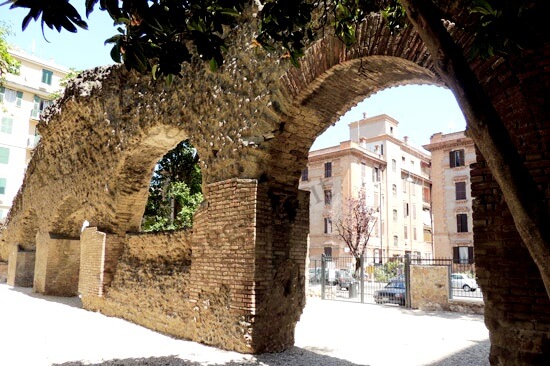
La Porticus Aemilia (Pórtico Emilio) era un vasto complejo de almacenes conectado con el puerto fluvial, que se construyó al sur del Aventino en el 193 a. C. Se terminó en el 174 a. C. con la ampliación del pórtico, que se levantaba en la zona situada detrás del Emporium, el mercado de mercancías. Paralelo al Tíber, medía 487 metros de largo y 60 de ancho, y estaba dividido interiormente en siete naves longitudinales, que descendían de dos en dos hacia el río, y cincuenta naves transversales, cubiertas por una serie de bóvedas perpendiculares a la fachada. Las estructuras conservadas, construidas en toba, se cuentan entre los ejemplos más antiguos de las técnicas constructivas empleadas en Roma y dan una idea de la grandiosidad del edificio.
The Porticus Aemilia was a vast warehouse complex connected to the river port, which was built south of the Aventine Hill in 193 BC. It was completed in 174 BC with the expansion of the Porticus, which stood in the area behind the Emporium, the marketplace for goods. Running parallel to the Tiber, it was 487 metres long and 60 metres wide, and was divided internally into seven longitudinal aisles, stepping down in pairs towards the river, and fifty transverse aisles, covered by a series of vaults at right angles to the façade. The surviving structures, built of tuff, are among the earliest examples of the construction techniques used in Rome and give an idea of the building’s grandeur.