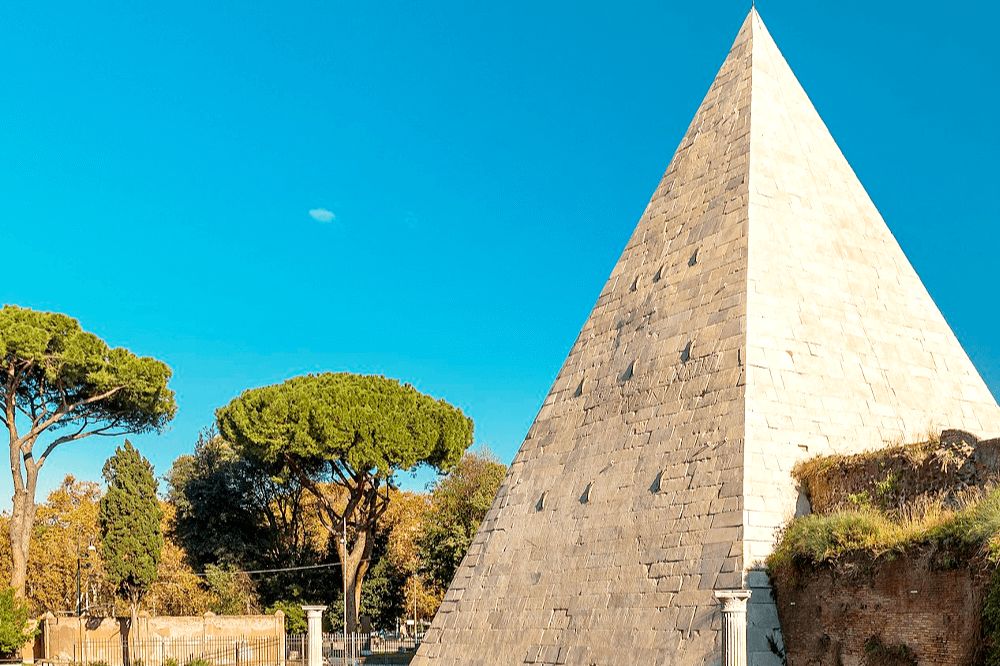
After Octavian (later Augustus) conquered Egypt in 30 BC, following the death of Cleopatra, Roman funerary architecture began to draw on Egyptian models, and pyramid-shaped tombs became a genuine fashion. The Pyramid of Cestius, built of concrete faced with slabs of Carrara marble, is 36.4 metres high with a square base of about 30 metres per side. It was built in the Egyptian style between 18 and 12 BC, in just 330 days. It was the tomb of Gaius Cestius Epulo, a praetor, tribune of the plebs and member of the Septemviri Epulonum, a priestly college, as one of the inscriptions on its façade records.
After Octavian (later Augustus) conquered Egypt in 30 BC, following the death of Cleopatra, Roman funerary architecture began to draw on Egyptian models, and pyramid-shaped tombs became a genuine fashion. The Pyramid of Cestius, built of concrete faced with slabs of Carrara marble, is 36.4 metres high with a square base of about 30 metres per side. It was built in the Egyptian style between 18 and 12 BC, in just 330 days. It was the tomb of Gaius Cestius Epulo, a praetor, tribune of the plebs and member of the Septemviri Epulonum, a priestly college, as one of the inscriptions on its façade records.