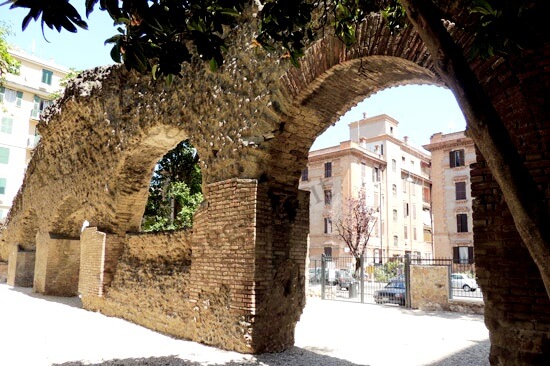
The Porticus Aemilia was a vast warehouse complex connected to the river port, which was built south of the Aventine Hill in 193 BC. It was completed in 174 BC with the expansion of the Porticus, which stood in the area behind the Emporium, the marketplace for goods. Running parallel to the Tiber, it was 487 metres long and 60 metres wide, and was divided internally into seven longitudinal aisles, stepping down in pairs towards the river, and fifty transverse aisles, covered by a series of vaults at right angles to the façade. The surviving structures, built of tuff, are among the earliest examples of the construction techniques used in Rome and give an idea of the building’s grandeur.
The Porticus Aemilia was a vast warehouse complex connected to the river port, which was built south of the Aventine Hill in 193 BC. It was completed in 174 BC with the expansion of the Porticus, which stood in the area behind the Emporium, the marketplace for goods. Running parallel to the Tiber, it was 487 metres long and 60 metres wide, and was divided internally into seven longitudinal aisles, stepping down in pairs towards the river, and fifty transverse aisles, covered by a series of vaults at right angles to the façade. The surviving structures, built of tuff, are among the earliest examples of the construction techniques used in Rome and give an idea of the building’s grandeur.